The certificate-based authentication for Azure IoT works like this:
- There will be a root certificate signed by a certificate authority.
- The root certificate will be uploaded to the Azure IoT Hub.
- For each IoT device we want to authenticate, we will create a separate client certificate, signed by the same certificate authority.
- At the time of the authentication, our IoT device will present the client certificate as the proof of identity.
- Azure IoT Hub will verify the identity based on the root certificate and the device name.
This document details how to create a certificate authority, a root certificate, and the client certificate(s).
As a first step, we need to generate the certificate hierarchy.
Create the following folder structure on your local drive to hold the various certificates in the hierarchy that we will be generating:
iotcerts/
├── ca/
└── certs/
    ├── device/
These are the steps that need to be completed for the certificate hierarchy:
Generate Root Certificate
Generate a private key file (ca.key) for the Root CA using the command below. You may choose to enter a passphrase to be associated with the ca.key file as well.
openssl genrsa -des3 -out ca/ca.key 4096
Generate a self-signed certificate (ca.crt) for the Root CA using the command below. This command generates a new self-signed X.509 certificate named "ca.crt" valid for 3650 days (10 years) using the RSA private key "ca.key". You will be required to enter the pass phrase associated with the private key file "ca.key".
openssl req -new -x509 -key ca/ca.key -days 3650 -out ca/ca.crt
$ openssl req -new -x509 -key ca/ca.key -days 3650 -out ca/ca.crt
Enter pass phrase for ca/ca.key:
You are about to be asked to enter information that will be incorporated
into your certificate request.
What you are about to enter is what is called a Distinguished Name or a DN.
There are quite a few fields but you can leave some blank
For some fields there will be a default value,
If you enter '.', the field will be left blank.
-----
Country Name (2 letter code) [AU]:US
State or Province Name (full name) [Some-State]:KS
Locality Name (eg, city) []:Stilwell
Organization Name (eg, company) [Internet Widgits Pty Ltd]:Cirrus Link Solutions
Organizational Unit Name (eg, section) []:Support
Common Name (e.g. server FQDN or YOUR name) []:CLS Example Root CA
Email Address []:
$
You should have the following files created:
iotcerts/
├── ca/
   ├── ca.crt
   ├── ca.key
Generate Device Certificate
Generate private key in PSCK8 format (device.key) for the device using the command below.
openssl genrsa -out certs/device/device.key 4096
Generate a Certificate Signing Request (CSR) for the device using the command below. This command generates a new CSR named "device.csr’ using the RSA private key "device.key".
openssl req -new -key certs/device/device.key -out certs/device/device.csr
$ openssl req -new -key certs/device/device.key -out certs/device/device.csr
You are about to be asked to enter information that will be incorporated
into your certificate request.
What you are about to enter is what is called a Distinguished Name or a DN.
There are quite a few fields but you can leave some blank
For some fields there will be a default value,
If you enter '.', the field will be left blank.
-----
Country Name (2 letter code) [AU]:US
State or Province Name (full name) [Some-State]:KS
Locality Name (eg, city) []:Stilwell
Organization Name (eg, company) [Internet Widgits Pty Ltd]:Cirrus Link Solutions
Organizational Unit Name (eg, section) []:Support
Common Name (e.g. server FQDN or YOUR name) []:Device01
Email Address []:

Please enter the following 'extra' attributes
to be sent with your certificate request
A challenge password []:
An optional company name []: $
Sign the Device CSR with the Device CA using the command below. This command will sign the CSR "device.csr" with the Root CA certificate ‘ca.crt’ and Root CA's RSA private key ‘ca.key’, creating a new X.509 certificate named ‘device.crt’ valid for 365 days (1 year). You will be required to enter the passphrase associated with the private key file "ca.key".
openssl x509 -req -in certs/device/device.csr -CA ca/ca.crt -CAkey ca/ca.key -CAcreateserial -out certs/device/device.crt -days 365
Import Server Configuration to IoT Hub
On the IoT Hub resource Overview page, click “Certificates” menu on the left blade, and click the “Add” button.
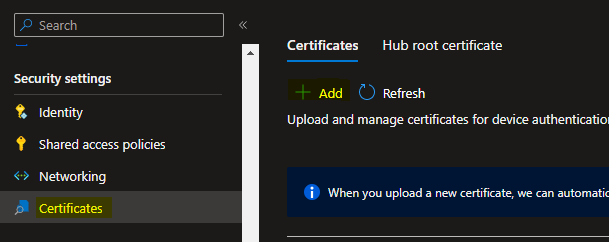
In the “Certificates” blade that appears, give a certficate name (eg. MyOrgIoTHubRootCertificate).
Browse to the IotCerts/rootca folder on your computer and import the rootca.pem. Check the “Set certificate status to verified on upload” checkbox.
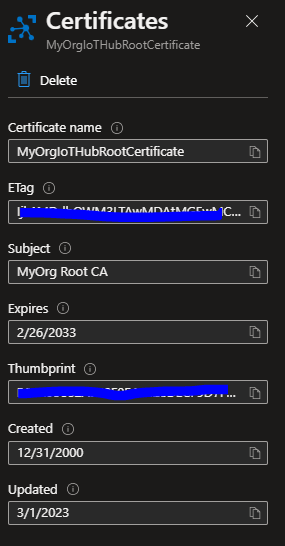
Click Save.
Create Logical Device myiotdevice1
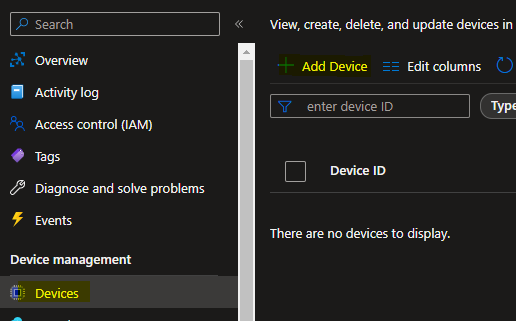
On the resource Overview page, click “Devices” menu on the left blade, and click “Add Device” button.
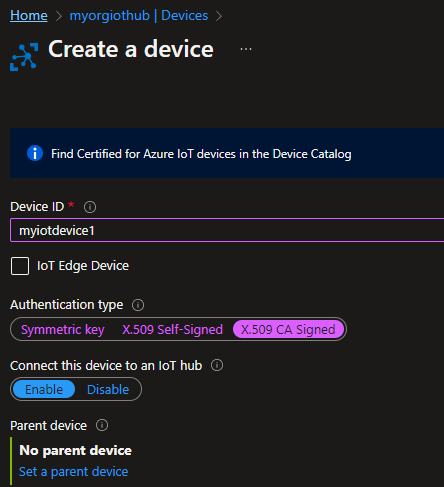
In the “Create a device” page that appears, give myiotdevice1 as the Device Id.
Select Authentication type X.509 CA Signed. Keep “Connect this device to an IoT Hub” as Enabled.
 it
it
Click Save.