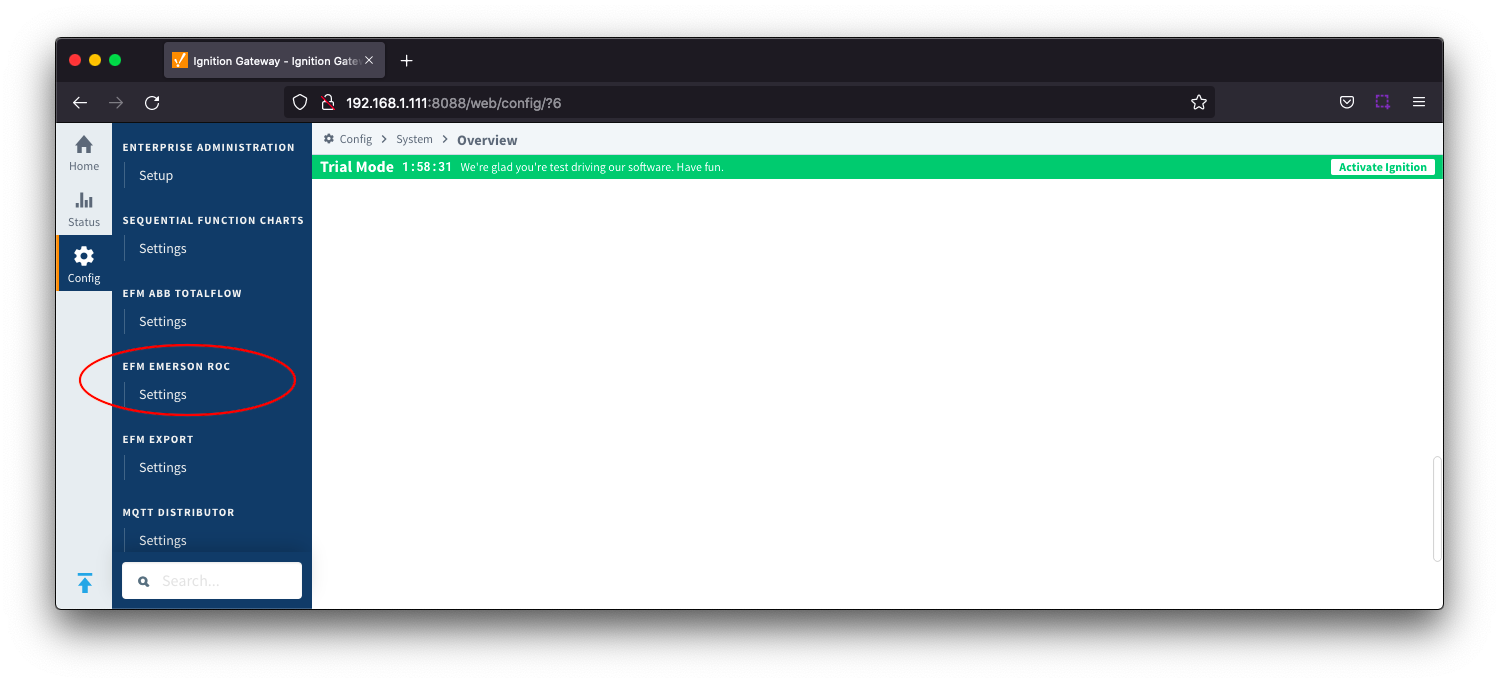
EFM Emerson ROC provides a configuration section to the Ignition Gateway and this can be seen in the left side menu bar of the Ignition Gateway web UI.
| Warning |
|---|
Once TLP Definitions and EFM Mappings have been configured, the following additional steps are required to get all Please review the EFM Emerson ROC Quickstart for all configuration steps required to pull data available from a ROC into Ignition: Create a device connectionSpecify the subset of TLP definitions that this specific ROC usesCreate TLP Template(s) which define groups of TLPs should be polled as a logical groupCreate TLP Poll Group(s) which specify the logical parameters associated with a given TLP Template. |
The configuration options for each of the two tabs - TLP Definitions and EFM Mappings are detailed below.
...
| Anchor |
|---|
| TLPDefinitions |
|---|
| TLPDefinitions |
|---|
|
TLP Definitions
...
| Note |
|---|
| If creating custom TLP Definitions files, each T and P parameter should be included only once. Any logic group (L parameter) is configured as part of the Emerson ROC Device Connection here |
EFM Mappings
The EFM Mappings are used for publishing EFM Records representing Events, Alarms, Configuration, and History entries that are polled from a device.
There are two tabs Configuration Mappings and Periodic Mappings
| Anchor |
|---|
| ConfigurationMapping |
|---|
| ConfigurationMapping |
|---|
|
Configuration Mappings
The configuration mapping files are used for building up EFM Configuration Records. They define which TLPs map to which fields (columns) in an EFM Configuration Record. Additionally they can provide bit and/or value mappings for the TLP values.
...
The periodic mapping files are used for building up EFM Periodic History Records. They define which TLPs map to which fields (columns) in an EFM Periodic History Record, the logical type of the point type table (meter, station, or input), and an archive type of the value.
...