Prerequisites
- Ignition with Google Cloud Injector Module installed
- Ignition Designer installed
- Review the Inductive Automation documentation for Launching Designer against the Ignition gateway
- An existing Clearblade IoT Core account with a Project, IoT Core registry, credentials, and device created.
- Documentation on getting started with the Clearblade IoT Core can be found here
Summary
This tutorial will provide step-by-step instructions for the following:
- Configuring the Google Cloud Injector Module to connect to an existing Clearblade IoT Core
- Publishing live Tag data and events to the connected Clearblade IoT Core
Upon completion of this module you will have an Ignition Gateway connected and publishing live Tag data to a Clearblade IoT Core.
Architecture
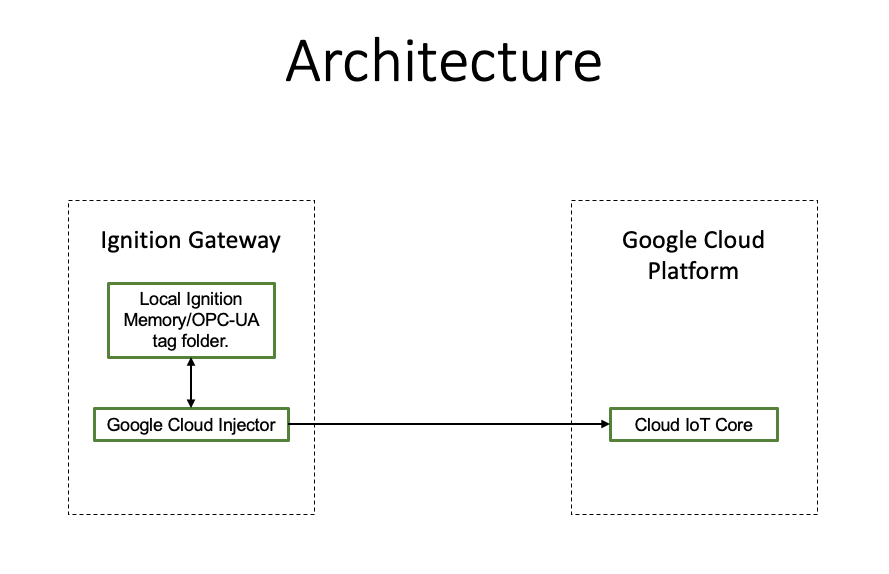
Tutorial
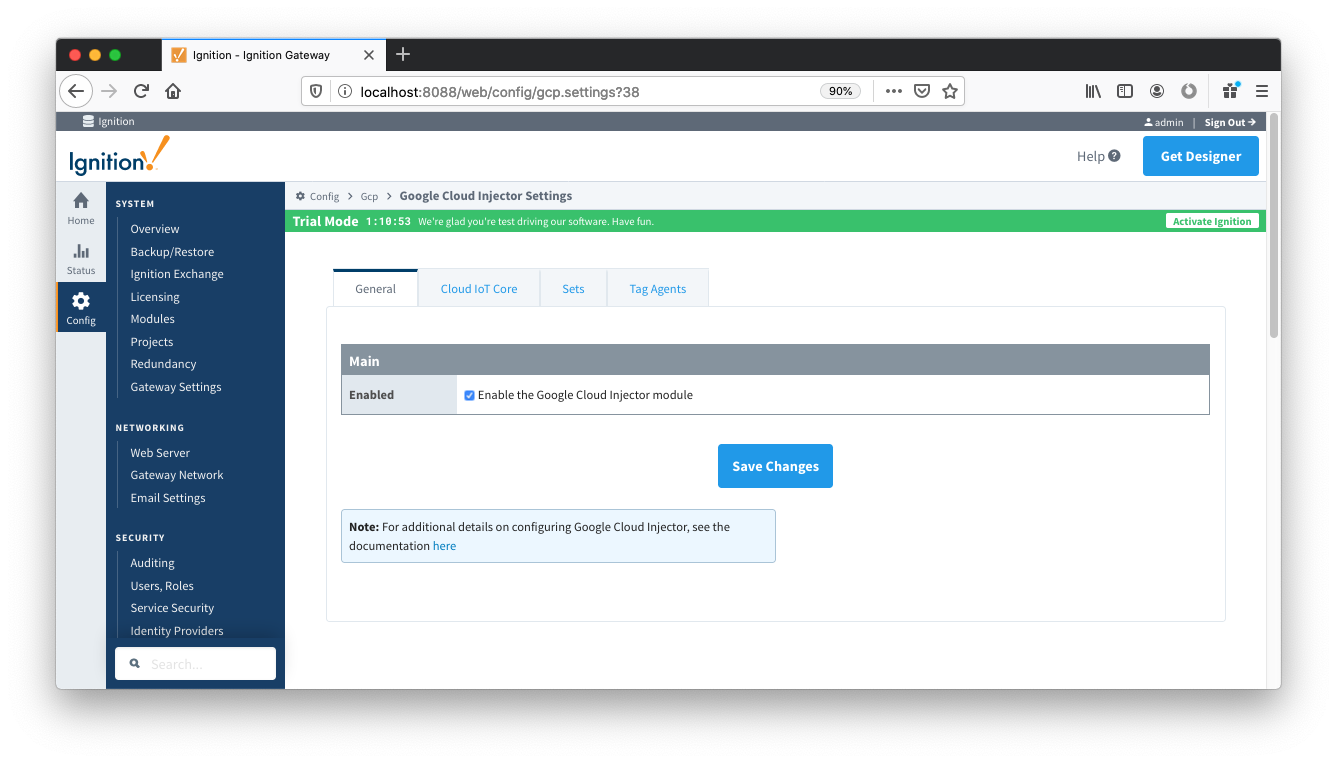
Once you have Ignition and the Google Cloud Injector Module installed and running we can setup the configuration to connect to your existing Clearblade IoT Core.
Navigate to the Google Cloud Injector Modules configuration section from the left side bar in the Ignition Gateway and select the Clearblade IoT Core tab.
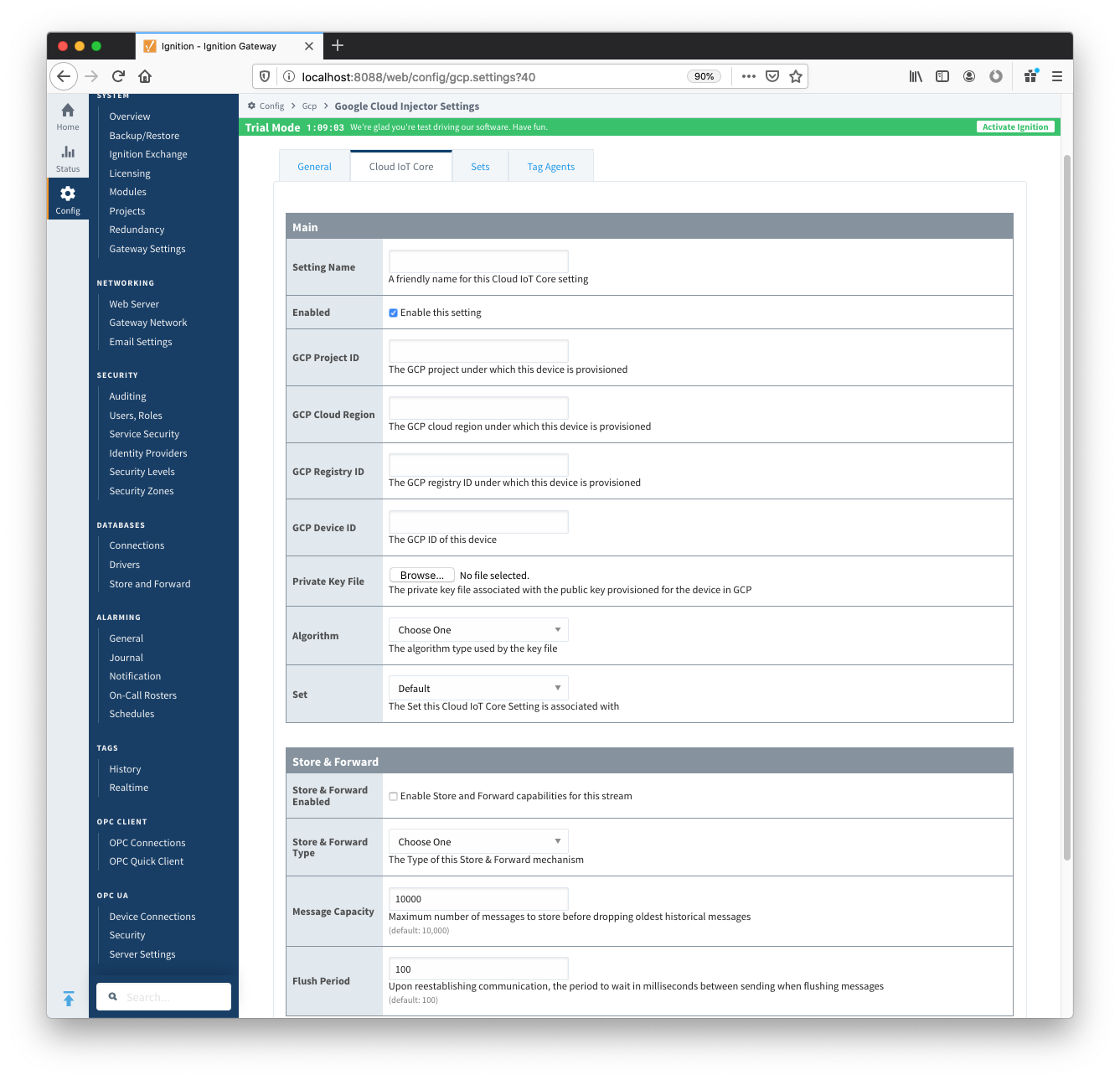
Set the following parameters:
- Setting Name
- This can be any unique identifier. For this tutorial we will use "TestSetting".
- GCP Project ID
- This is the ID of the project that was created with the Google Cloud Platform account.
- GCP Cloud Region
- This should be obtained from the Cloud IoT Core that was created.
- GCP Registry ID
- This should be obtained from the Cloud IoT Core that was created.
- GCP Device ID
- This should be obtained from the Cloud IoT Core that was created.
- Private Key File
- The Private Key File must be in PKCS8 DER format. See Google's documentation here on how to convert a PEM to PKCS8 DER format.
- Algorithm
- Algorithm type used by the key file. Options are RS256 and ES256
Click on "Create New Cloud IoT Core Setting" to save create the new configuration setting.
Now the Google Cloud Injector module is connected to the Cloud IoT Core, we have to determine if there are are changes needed to the Tag Agent tab to be able to push data.
If you already have Ignition tags defined, for example from the Ignition OPC UA Server, then depending on the depth of your tag tree you may need to configure the Sparkplug Settings.
Once the Tag Agent is setup as needed, you can jump to Step 3: Publishing data.
If you do not have Ignition tags defined, that will be done in the next step with a tag tree depth that requires no additional Sparkplug settings.
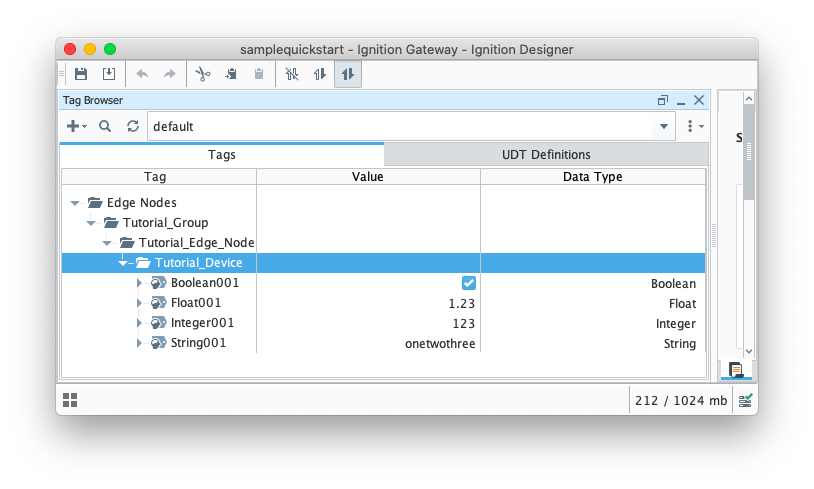
When the Google Cloud Injector module is installed in Ignition, an Edge Node folder is automatically created in the 'default' Ignition tag provider.
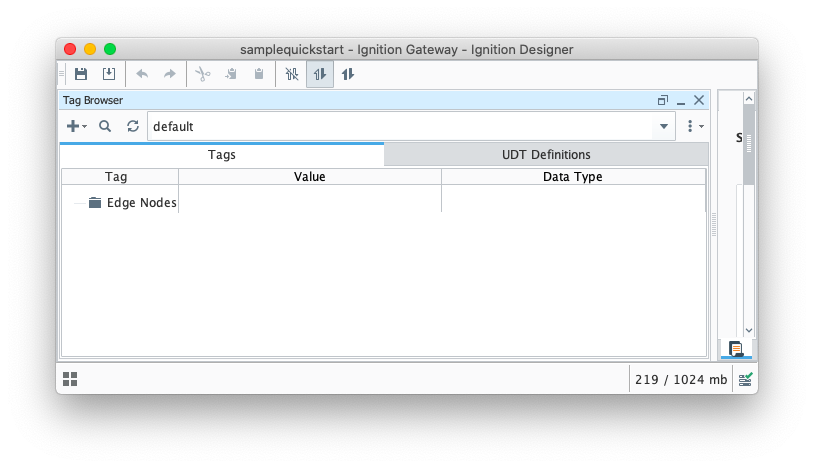
Create a tree structure under this folder as shown below with some memory tags - this folder structure creates the same hierarchy that is described in the Sparkplug B specification of Group ID, Edge ID, and Device ID.
Step 3: Publishing data
When the Google Cloud Injector module is installed in Ignition, a Google Cloud Injector tag provider is automatically created. This folder will contain both information tags about the module's version and state, as well as control tags for refreshing the module and Tag Agents.
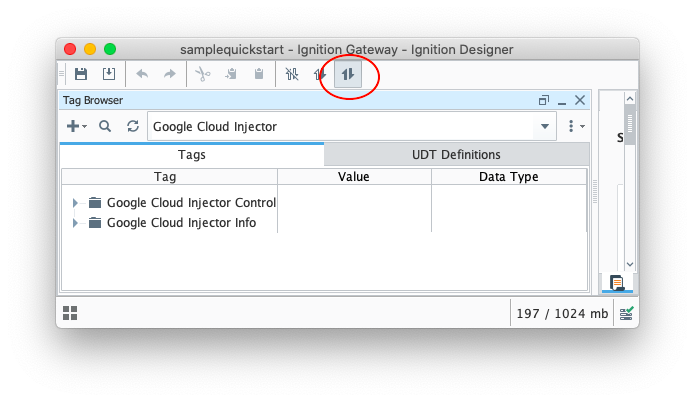
Make sure that the Ignition Designer has read/write communications turned on by selecting the Project/Comm Read/Write button highlighted in the image below.
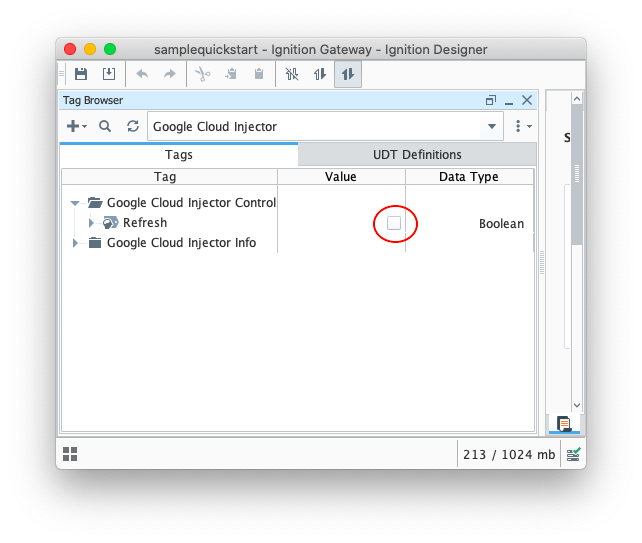
To refresh the default Tag Agent, open the folder "Google Cloud Injector Control" and click on the Refresh Boolean. When this happens, the Tag Agent will scan the "Edge Nodes" folder and find the new Memory Tags that we have created, construct JSON payloads representing those tags with their current values and publish the payload to the Cloud IoT Core that we have configured.
The Google Cloud Injector Tag Agent will publish two JSON payloads to the Cloud IoT Core. The format of these messages closely follows the Sparkplug B Specification's payload structure.
The first payload represents the Edge Node and will contain the following:
- The Sparkplug elements: Namespace, Group ID, Edge Node ID. They will be grouped under "topic".
- A "timestamp" for when the payload was constructed.
- A "bdSeq" sequence number to track the "session" of the Tag Agent.
- Any Edge Node tags defined in the "Tutorial_Edge_Node" folder (in our example we have none).
It will look something like this:
{
  "topic": {
    "namespace": "spBv1.0",
    "groupId": "Tutorial_Group",
    "edgeNodeId": "Tutorial_Edge_Node"
  },
  "payload": {
    "timestamp": 1504739061495,
    "metrics": [
      {
        "name": "bdSeq",
        "timestamp": 1504739061495,
        "dataType": "Int64",
        "value": 0
      }
    ],
    "seq": 0
  }
}
The second payload represents the Device and will contain the following:
- The Sparkplug elements: Namespace, Group ID, Edge Node ID, Device ID. They will be grouped under "topic".
- A "timestamp" for when the payload was constructed.
- Any Device tags defined in the "Tutorial Device" folder.
It will look something like this:
{
  "topic": {
    "namespace": "spBv1.0",
    "groupId": "Tutorial_Group",
    "edgeNodeId": "Tutorial_Edge_Node",
    "deviceId": "Tutorial Device"
  },
  "payload": {
    "timestamp": 1504739061501,
    "metrics": [
      {
        "name": "Boolean001",
        "timestamp": 1504739061546,
        "dataType": "Boolean",
        "properties": {
          "Quality": {
            "type": "Int32",
            "value": 192
          }
        },
        "value": true
      },
      {
        "name": "String001",
        "timestamp": 1504739061546,
        "dataType": "String",
        "properties": {
          "Quality": {
            "type": "Int32",
            "value": 192
          }
        },
        "value": "onetwothree"
      },
      {
        "name": "Integer001",
        "timestamp": 1504739061546,
        "dataType": "Int32",
        "properties": {
          "Quality": {
            "type": "Int32",
            "value": 192
          }
        },
        "value": 123
      },
      {
        "name": "Float001",
        "timestamp": 1504739061546,
        "dataType": "Float",
        "properties": {
          "Quality": {
            "type": "Int32",
            "value": 192
          }
        },
        "value": 1.23
      }
    ],
    "seq": 1
  }
}
Step 4: Use Ignition Designer to Publish Tag Data (Live Tag Changes)
Now we can change the values of the new Memory Tags and generate payloads that contain the Tag change events. Click on the value of the "Boolean001" Memory Tag to change the value.
This will result in the following payload to be constructed to represent this Tag change event and pushed to the Cloud IoT Core:
{
  "topic": {
    "namespace": "spBv1.0",
    "groupId": "Tutorial_Group",
    "edgeNodeId": "Tutorial_Edge_Node",
    "deviceId": "Tutorial Device"
  },
  "payload": {
    "timestamp": 1504740884529,
    "metrics": [
      {
        "name": "Boolean001",
        "timestamp": 1504740883526,
        "dataType": "Boolean",
        "value": true
      }
    ],
    "seq": 2
  }
}
It is beyond the scope of this tutorial to show how to design an application in Google Cloud Platform to handle the payloads as they are pushed in to the Cloud IoT Core. For additional information on developing applications to consume this data see https://cloud.google.com/iot-core/.
Additional Resources
- Inductive Automation's Ignition download with free trial
- Cirrus Link Solutions Modules for Ignition
- Support questions
- Sales questions
- About Cirrus Link